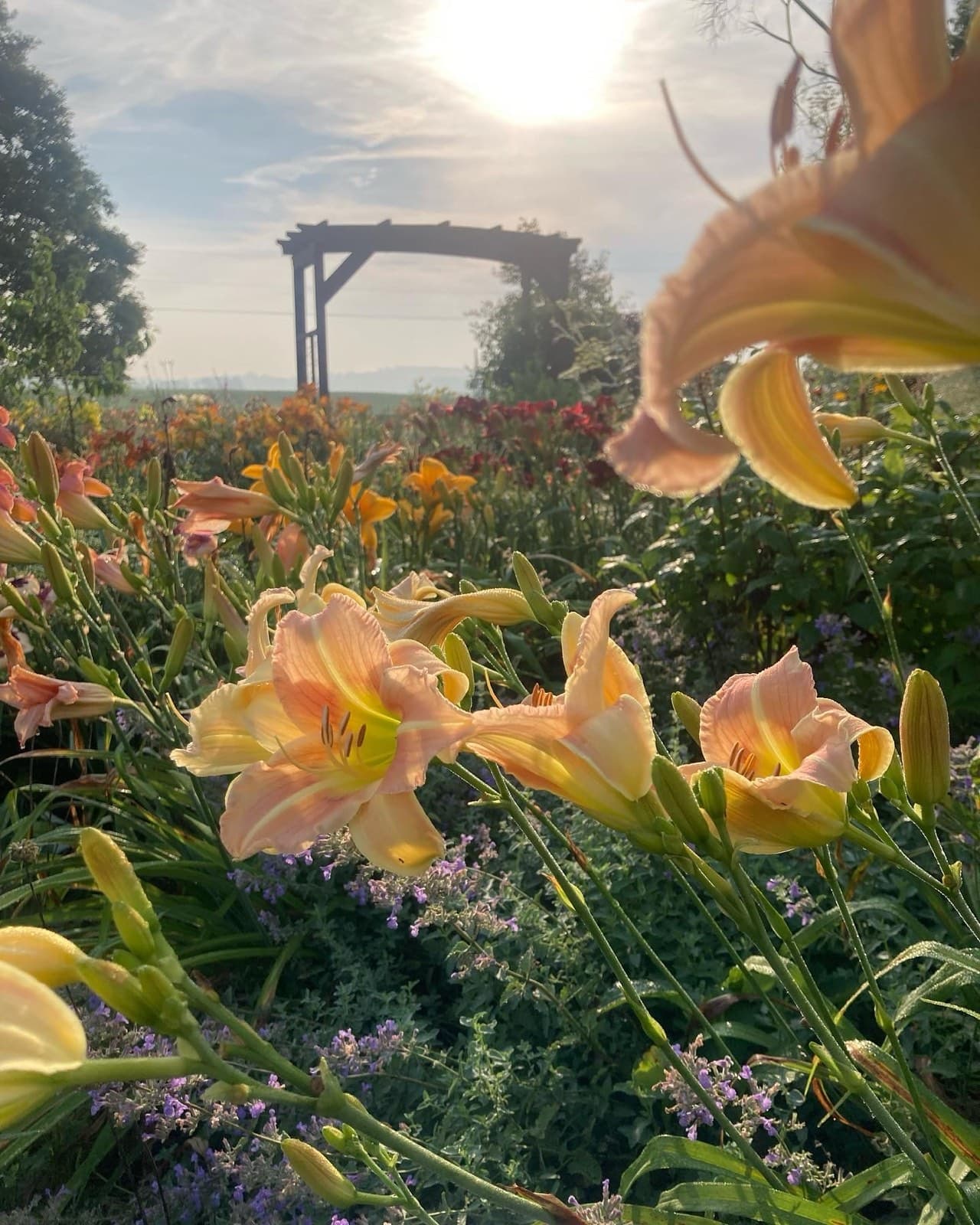
Welcome
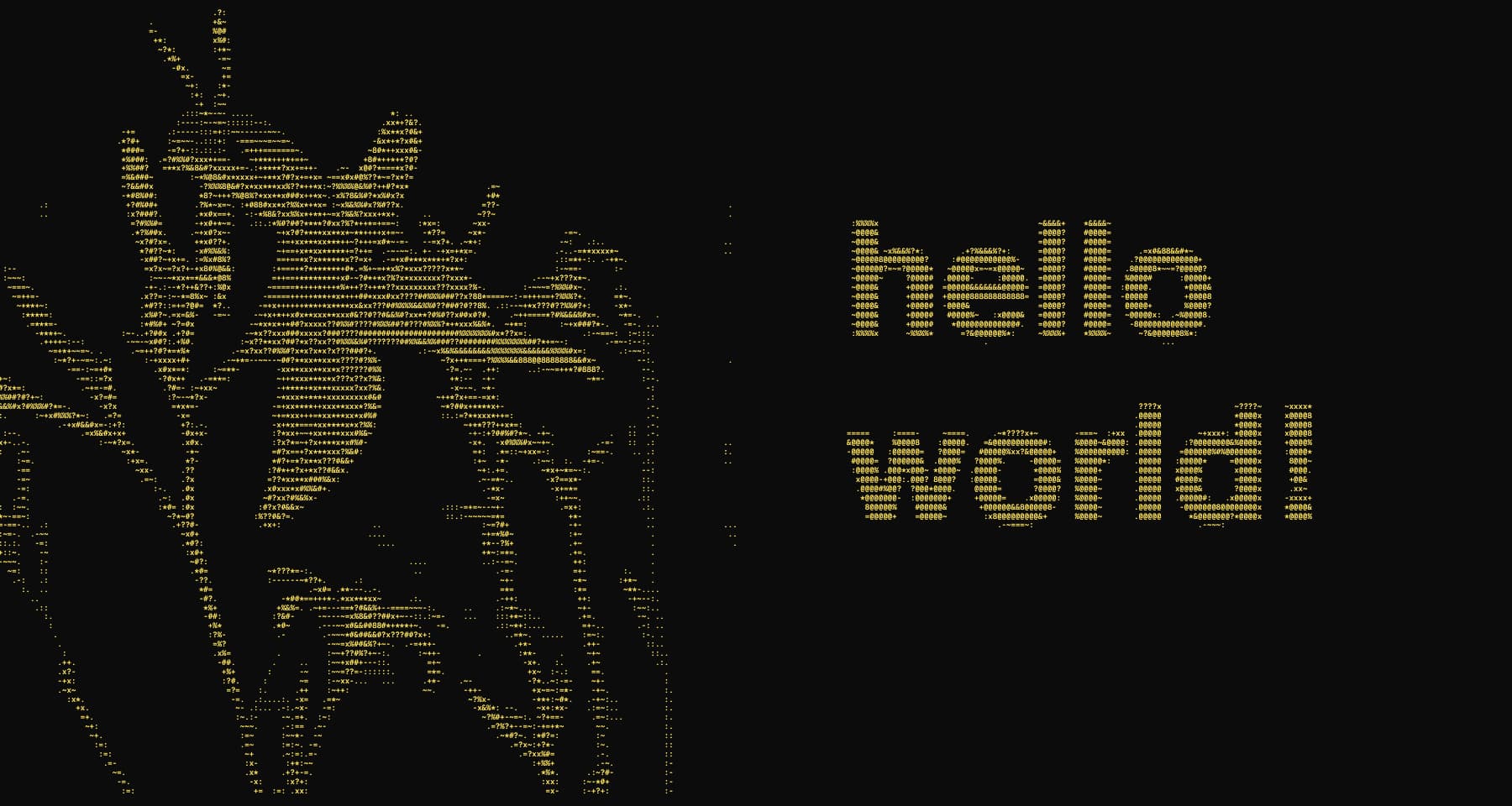
Introduction: Hello World!
How a childhood gardening obsession turned into a daylily breeding program and this site.
The first daylily I ever really looked at wasn't one of the daylilies I know now. It was the orange thing growing up against my grandma's garage that she couldn't kill.
In middle school I was the kid who cornered my art teacher, Cynthia Perkins, to report on whatever plant was my "favorite" for a given week. She humored me through the whole garden catalog: roses, iris, catmint, dahlias, helenium, on and on. One day she said: you should look into these plants I grow, daylilies. I'd just spent a summer binge-watching a decade of Gardeners' World, so I figured I already knew most things about daylilies: the orange ditch lily (Hemerocallis fulva) and the parking-lot 'Stella de Oro'. Then she told me about the variation. The colors, the forms, and that you could make your own new ones by crossing them, something she called hybridizing. I thought it was the coolest thing I'd ever heard.
I can't help but keep coming back
There are plenty of great garden plants with beautiful flowers, so why daylilies? Simple: hardiness. I have always bounced from one thing to the next, so I rarely do one thing forever. I often venture off toward whatever new thing has caught my attention, and when I'm done, the daylilies are there when I come back, still blooming, still beautiful, despite the neglect.
From the very start, the thing that really caught my attention over other beautiful flowers wasn't, ironically, the flower, but rather the concept of making more plants. I was obsessed with propagation, whether it's divisions, cuttings, or every other technique I could watch a YouTube tutorial about, and eventually I discovered tissue culture. That field's discovery pushed me to pursue my degree in biotechnology.
Hybridizing is a more creative version of that same itch, and as someone who has been an artist longer than I've been a gardener, making my own unique daylilies, constantly iterating and improving my creations, ticks all the right boxes as something I enjoy doing. Like most artists, as I've practiced more, my style has become more distinct, the tools I use have gotten sharper, and their applications more judicious: better frameworks, better stock plants, more complex crossing schemes, concepts and theories of inheritance, and lately more statistical and quantitative approaches, which is why daylilies have never once gotten boring.
The authors that set my trajectory
Mrs. Perkins didn't just point me at daylilies. She handed me a stack of carefully selected issues of old daylily journals, and some of the best writing I have ever read was in them: Sandy Holmes on petal substance and qualities, Carol Emmerich on the variations and colors you can get out of a single parent, and Gil Stelter on species breeding in tetraploids to introduce vigor back into modern stock. That last idea sold me, and it still shapes how I think today. Those articles set my trajectory before I'd grown a single seedling of my own.
So at 13, with almost no money, I scraped together $60 for my first order from Oakes Daylilies, almost entirely off the discount page, because it was cheapest. Even then I was thinking like a breeder: I tried to buy one of every color and form I could afford, so I'd have the most to work with once I started crossing. (I had no idea most of them weren't fertile, or what a tetraploid even was.) I still remember the list: 'Ed Murray', 'Orange Vols', 'Woodside Warrior', 'White Stripe', 'Bubbly', 'Miss Amelia', and a bonus double fan of 'Crimson Shadows'. When they arrived bare-root I dug my first bed myself as a little seventh grader, about three feet wide and a good 16 to 20 feet long. I was so proud of it.
The next spring I found the Louisville daylily folks selling double fans for $5 at the local plant fair, and I never looked back. That's where I picked up varieties I'd love for years: 'Kindly Light', 'Indian Giver', 'Sona's Song' (Verna Habermel, 2004), and many others I still grow to this day.
Learning by failing
In high school I got serious, or thought I did. I decided I was going to make a diploid purple spider with teeth, so I crossed 'Kindly Light' (Lemoine J. Bechtold, 1950) with 'Indian Giver' (Drew Ferguson, 1991) hundreds of times over several seasons. There were literally hundreds of seedlings, and only one might have been good enough to be lined out as an introduction, and even it failed my tests.
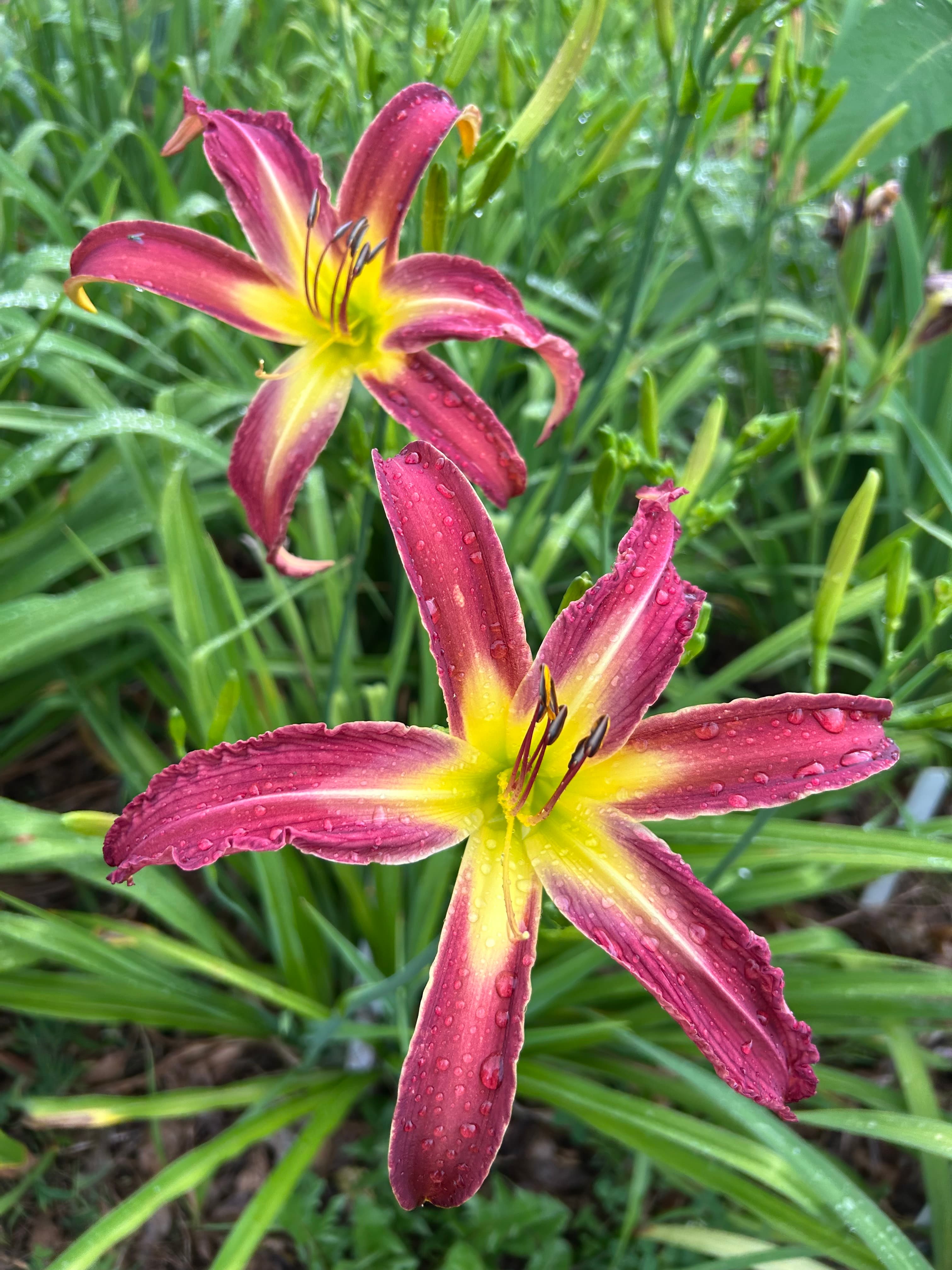
With what I know now, aiming a specific cross at teeth was always a long shot. Teeth have only recently started showing up in the diploids at all, in introductions like 'If Pelicans Could Smile' (Kimberly McCutcheon, 2018) and 'Light Fandango' (Ron Reimer, 2022), so that pairing was never going to be the vehicle I wanted it to be. But those seedlings taught me more than a purple spider with teeth ever could have: how two parents actually combine, how much variation a single cross can throw, which traits were passed on from parent to seedling and which weren't, and how some changed or shifted expression.
Not every serious effort earns an introduction, and sometimes the cross you never planned gives you your best plant.
My one introduction to date, 'Baby Steps' (2025), is a good example of the lesson. It was made at the same time as the 'Indian Giver' and 'Kindly Light' crosses, from a cross I don't remember planning or even doing, and a majority of its siblings were discarded early on. Over time 'Baby Steps' showed itself to be better than all my other seedlings from those years. (It was introduced a year earlier than I intended; I filled out the registration form a few weeks early, by accident.) I'll probably go over it in more detail later on, both why it's "great" and, more importantly, where, how, and why it needs improvement. A balanced, thorough perspective will always provide more useful insight than upselling a plant's great qualities.
The people this all came from
The daylily world turned out to be far bigger, and far more welcoming, than a teenager from rural Kentucky buying discount fans online could have guessed. In college I met Randy Dinkins, a USDA geneticist, who slowly walked me into the deeper end of hybridizing, with things like selection and trait dimensions, and a big emphasis on branching, which I've come to notice almost before the flower sometimes. He pointed me to Brian Reeder, and we've spent hours on species and historic crosses and breeding for disease resistance, all of which I think the modern daylily badly needs, or at least could greatly benefit from engaging with thoroughly. Randy also took me to my first regional meeting, where I met Sandy Holmes, whose article on petal substance had reached me years earlier through Mrs. Perkins's old journals, and whose 'I Lava You' was my mom's favorite flower in my garden. He also introduced me to John and Annette Rice, who became close friends. I grow a lot of their plants, and my favorite variety of all that I grow is their 'Old Friends': a plant I somehow own without remembering buying, and one whose tag I lost. I had to ask many experts what it might be, and finally rediscovered its name on a visit to David Kirchhoff.
I don't list all these names to drop them. I list them because nearly everything I know reached me through happenstance: a teacher's hand-me-down journals, an afternoon with someone who'd been breeding longer than I'd been alive. A lot of that knowledge was never written down, and the people holding it are getting harder to reach. (Annette has since retired and sold the farm.) That quiet fact is the ground this whole site is built on.
Learning to see the whole record
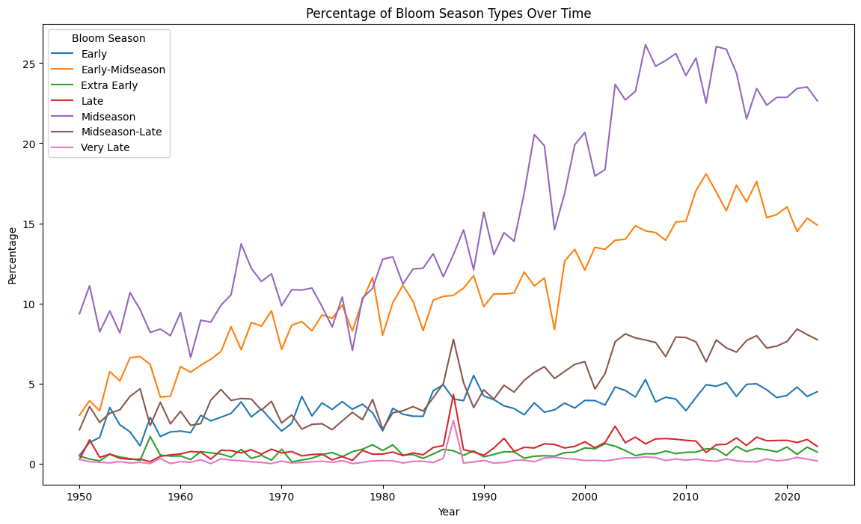
Somewhere in that journey I started wanting to see the entire picture at once. After I graduated in 2020 I taught myself some data tooling and built a notebook that compiled the public daylily registration record into something I could actually analyze. I explored trends over time, pulled parentage fields apart, and built the first rough pedigree and hybridizer-network graphs. That notebook is the direct ancestor of the Visualizer you'll find on this site. I leaned on modern tools to get there faster than I could have alone, but to be clear, the tools are not the point; what we can learn from them and how we use them is. And as a daylily community, the daylily database is an invaluable source of decades of information no one person could ever hope to collect on their own. A moment that further cemented my track came after my first talk at the Shirley Farmer Hybridizers meeting: a longtime breeder came up and told me my chart of introduction seasons matched what he'd worked out by hand, over months. That's when I knew there was something worth pulling out of the data.
What Hemeroholics is (so far)
The name is an old joke in the daylily world. The botanical name is Hemerocallis, and enough of us are cheerfully addicted that "hemeroholic" (a person hooked on daylilies) basically writes itself. Of all the names I considered, it's the one that stuck, partly because it's loose enough to grow into whatever this ends up being.
And I'm still figuring out exactly what that is. For now: obsessive, technical tooling and writing to help people, whether they're brand-new or lifelong enthusiasts, make better daylilies, from someone who cares a great deal about the future and quality of daylily. I'm still learning, and still refining; every year or two I overhaul my whole approach and look at my program through a new lens. Last year gave me my first big flush of seedlings, roughly 1,000 blooming at once, and I have more waiting to go in the ground than I'll admit to in writing. I have several ideas for this blog and Hemeroholics going forward, some of which I have alluded to here. Lots of esoteric questions, like: what is quality, how do you make a new daylily, how do you read and maybe analyze a pedigree, and even why reaching back into old lineages can often reintroduce traits that have long been lost, plus a few explorations I haven't thought out yet.
Obviously, I'm just another guy on the internet, but if it helps: I have a bachelor's in agricultural and medical biotechnology from the University of Kentucky, a couple of data-analytics certificates from 2025, and, more than any of that, a decade of very good mentors and a great many dead seedlings.
Welcome. I'm glad you're here.